In this guide ▾
Vatican City wall is the phrase most people use for the old fortified circuit around St. Peter’s, and it is a bit more complicated than one clean line on a map. The walls you notice today are the product of many centuries of building, repair and reuse. I’ll walk you through who started them, how they changed, and where you will actually meet them on a visit.
If you are here to plan a trip, the short version is this: you do not need a ticket to look at the outside of the walls, but you do need one to see the museums, the chapel and the Basilica areas that sit behind them. I’ll point out the best spots as we go. If you want the full picture of tickets first, you can see every ticket type side by side and come back.
Is the Vatican City Wall Real, and Is the State Walled?
The Vatican City wall is real, a set of historic walls rather than a modern fence added for security. The official Vatican State history page says that Pope Leo IV (847-855) chose the site beside St. Peter’s tomb to build the first walls of the civitas, which became known as the Leonine Walls.
That is the direct answer to “is the Vatican City walled?”. There is a wall, it has a long history, and it was first built in the 9th century.
The more careful answer is that the wall and the modern state are not the same thing in every place. The Vatican today is a tiny sovereign state, and its practical edge is a mix of old fortifications, buildings that form a continuous front, and open areas. The biggest mistake I see visitors make is picturing one tall stone ring with a single gate. It is closer to a patchwork. Some stretches are medieval and Renaissance masonry, some are later walls, and some are simply the backs of large buildings.
For visitors, that patchwork means the wall is not one landmark you tick off. You see it in pieces as you move between the Museums, the Basilica and the surrounding streets.
 Want a closer look? Vatican: Museums & Sistine Chapel Entrance Ticket, from $36See times →
Why Was the Vatican City Wall Built?
The Vatican City wall was built to shield the zone around St. Peter’s Basilica, by then one of the foremost Christian pilgrimage sites. The state’s own history page explains that the presence of Peter made the area a topographic fulcrum for two millennia, and that many people chose to be buried close to him.
 Book aheadVatican: Museums & Sistine Chapel Entrance TicketCheck availability · from $36
That matters because a rich, busy pilgrimage site outside the old city limits was exposed. Rome’s earlier Aurelian Walls ran elsewhere, so the area around Peter’s tomb sat beyond them. The same problem hit another great church: Wikipedia notes that St. Paul Outside the Walls lay outside the Aurelian Walls and was damaged in the 9th century during a Saracen raid. As a result, Pope John VIII (872-882) fortified that basilica, its monastery and the nearby homes.
So the logic is easy to follow. Churches built over the tombs of apostles grew rich and busy, they stood outside the main city wall, and popes responded by walling them in. Leo IV did it for St. Peter’s. John VIII did a smaller version of the same thing at St. Paul’s.
 Skip the ticket line: Rome: St. Peter's Basilica, Dome Climb, and Underground Tour, from $33Check dates →
Who Built the Leonine Walls?
The Leonine Walls were built by Pope Leo IV (847-855), and they also gave the area its name, the Leonine City. The Vatican State history page describes the walls as the first of the civitas, and says the Leonine City became the spiritual heart of Rome throughout the Middle Ages and the Renaissance.
I want to be careful with numbers here. Many websites quote exact heights, lengths and completion years for the Leonine Walls, but the official sources I am drawing on do not give those figures, so I will not repeat them as fact. If you see a precise height or length quoted, treat it as unverified unless it links to an official or scholarly source.
What the official history does give us is a useful timeline of how the area around the walls developed:
| Period | What happened | Source |
|---|---|---|
| 324 A.D. or so | Constantine begins a large church over the tomb of Saint Peter | Vatican State history |
| 847-855 | Leo IV builds the first walls of the civitas, later called Leonine | Vatican State history |
| 872-882 | John VIII fortifies St. Paul’s basilica and its monastery after a Saracen raid | Wikipedia |
| 1145-1216 | First palace completed under Eugene III and Innocent III | Vatican State history |
| Late 1200s to early 1300s | Palace expanded and the Leonine Walls restored | Vatican State history |
| 1309 | The Papal See moves to Avignon and Rome and St. Peter’s are abandoned for over a century | Vatican State history |
I find that table is the quickest way to stop mixing up the layers. Peter’s tomb comes first, then the church, then the walls, then the palace.
 Short on time? Rome: St. Peter's Basilica, Papal Tombs, and Dome Climb Tour, from $60Book a slot →
How Has the Vatican City Wall Changed Over Time?
The Vatican City wall changed through repeated restoration and reworking, not a single build left untouched. The official history says that the Leonine Walls underwent restoration works between the end of the 1200s and the early 1300s, at the same time the palace beside St. Peter’s was being expanded.
Then came a gap. In 1309 the Papal See moved to Avignon, and both Rome and St. Peter’s were abandoned for over a century, according to the same page. Any wall around an abandoned area is going to suffer, and that is part of why later popes spent so much effort on repairs and new works.
One thing I would flag for readers is that older popular sources often say later popes added bastions and extensions. That is plausible, but the brief of official pages I am working from does not name those popes or dates, so I will not list them. What you can safely say is that the visible wall is a mix of work from different centuries, and that the Leonine circuit is the starting point.
Ancient ground under the wall
The ground under the wall mattered long before Leo IV arrived. The state history describes the Vatican area in Roman times as outside the city, with villas, the gardens of Agrippina and a vast necropolis along the main roads. Caligula built a small circus there, later renovated by Nero, and tradition says Saint Peter was martyred there in 64 A.D.
When the Constantinian church was built, stones from Nero’s ruined circus were reused. That reuse is typical of the whole site. Roman stone, early Christian building and medieval repair are all stacked together.
 Prefer a guide? Vatican Museums, Sistine Chapel & St. Peter's Basilica Tour, from $60See tours →
Where Can You See the Vatican City Wall Today?
You can see the Vatican City wall most easily on the approach to the Vatican Museums, where you walk along a long outer wall on Viale Vaticano. One of the tour meeting instructions in the booking data tells you to go directly to the Vatican Museum entrance on Viale Vaticano, so you will be walking beside the high enclosing masonry as you queue.
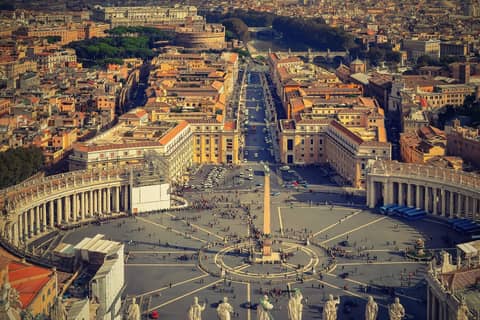
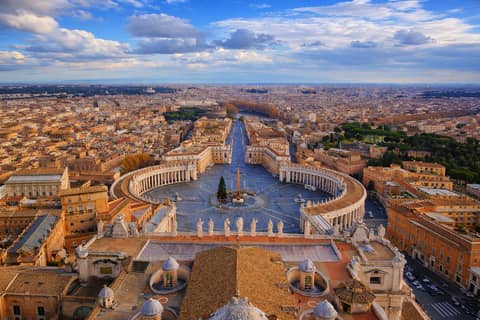
The second place is around St. Peter’s Square and the Basilica, where the Colonnade and the surrounding buildings make the front edge of the state. If you are working out which side is which, my page on where the Vatican is in Rome gives you the layout.
Here is where I would stand if you want good views of the outside of the enclosure:
- Viale Vaticano, the street you follow to the Museums entrance, for the long outer stretch.
- The edge of St. Peter’s Square, where the Colonnade frames the entrance to the state.
- Streets around the Museums exit, where you see the back of the complex and where several tour companies have their offices.
Vatican Museums
Art museum · ★ 4.6 · 213,480 Google reviews
00120 Città del Vaticano, Vatican City
Opening hours
- Friday8 am–8 pm
- Monday8 am–8 pm
- Saturday8 am–8 pm
- SundayClosed
- Thursday8 am–8 pm
- Tuesday8 am–8 pm
- Wednesday8 am–8 pm
Saint Peter’s Basilica
Basilica · ★ 4.8 · 185,703 Google reviews
Piazza San Pietro, 00120 Città del Vaticano, Vatican City
Opening hours
- Friday7 am–7:10 pm
- Monday7 am–7:10 pm
- Saturday7 am–7:10 pm
- Sunday7 am–7:10 pm
- Thursday7 am–7:10 pm
- Tuesday7 am–7:10 pm
- Wednesday7 am–7:10 pm
None of these needs a ticket. You are looking at the outside, on public streets.
 Planning ahead? Rome: Vatican Museums, Sistine Chapel & Basilica Tour, from $71Check availability →
Can You Walk Along or Go Inside the Vatican City Wall?
You can walk along the Vatican City wall from the outside on public streets, though not on top of it. For the interior, the practical route is through a ticketed site, and the two big ones are the Museums and the Basilica area.
The maps data lists the Museums as open from 8 am to 8 pm on weekdays and Saturdays and closed on Sundays, and lists St. Peter’s Basilica as open from 7 am to 7:10 pm every day. Those hours come from a map listing, so please confirm them on the official Vatican Museums site before you go, because hours and closures change.
If you want the “inside the walls” experience, the Gardens are the other option. My guide to the Vatican Gardens covers what is on offer there.
What the inside looks like
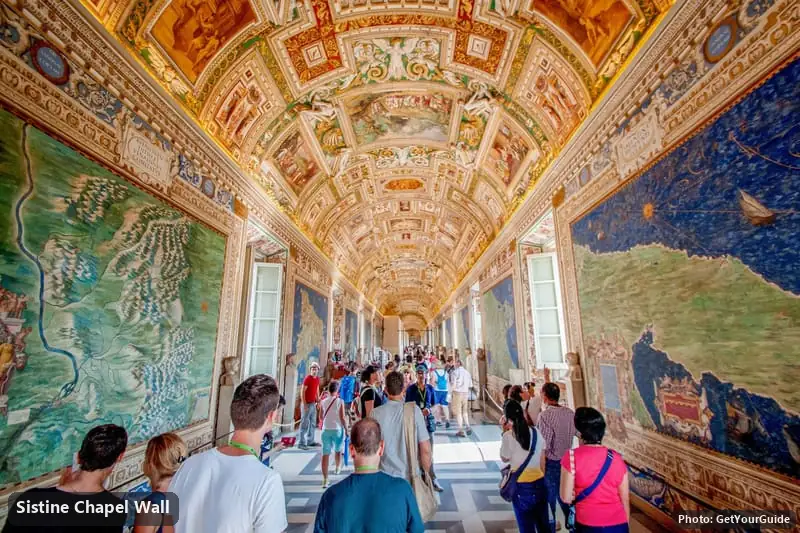
Inside the Vatican City wall, the Museums lead on toward the Sistine Chapel, where the word “wall” means something else. The official Museums page describes the chapel’s 15th-century decoration of the walls: the false drapes, the Stories of Moses and of Christ, and the portraits of the Popes, all painted in a team effort by Perugino, Botticelli, Ghirlandaio and Cosimo Rosselli, starting in 1481 and concluded in 1482.
So when people search for “Vatican wall” they may mean the fortifications, or they may mean these painted walls. If you came for the paintings, my page on Sistine Chapel tickets is the better starting point.
 Most booked this week: Vatican Museums & Sistine Chapel Skip-the-Line Entry Ticket, from $53See prices →
Is It Worth Booking Something to See Behind the Walls?
Booking a ticket behind the walls is worth it if you want to see the inside of the enclosure, since the outside alone is a short stop. I would not plan a trip around the wall itself. I would treat it as the opening scene for a Vatican day, then go in.
My advice is simple. If you want art, book the Museums and Sistine Chapel entry. If you want the Basilica and its underground areas, book a guided Basilica tour. The tours below cover both options.
Vatican: Museums & Sistine Chapel Entrance Ticket
Powered by GetYourGuide · affiliate link
Rome: St. Peter's Basilica, Dome Climb, and Underground Tour
Powered by GetYourGuide · affiliate link
Rome: St. Peter's Basilica, Papal Tombs, and Dome Climb Tour
Powered by GetYourGuide · affiliate link
The Museums entry ticket is a timed entry with a dedicated entrance, and its listing says to show your ticket to the security guards, then scan it at the box office. It also notes that you should not arrive outside your assigned time slot. The Basilica tours include the dome climb and the underground grottoes, and one listing mentions touching the original 4th-century Basilica walls, which is a nice link back to the theme of this page.
One traveler’s warning is worth repeating:
“This tour was an amazing experience! Our guide, Sylvia, was excellent! She was extremely knowledgeable and very well spoken, and kept the tour exactly on time. I would definitely recommend this tour, and Sylvia as the guide, to anyone interested in visiting the Basilica. Just be aware, the stairs to the top of the dome are no joke!! :)”
If you are comparing options, I’d start with the museum entry and the Basilica together, because they are the two sites that most visitors want. My overview of the Basilica shows what to expect inside.
Best value pick: Vatican: Museums & Sistine Chapel Entrance Ticket, from $36View dates →The Vatican City Wall and the Churches Outside It
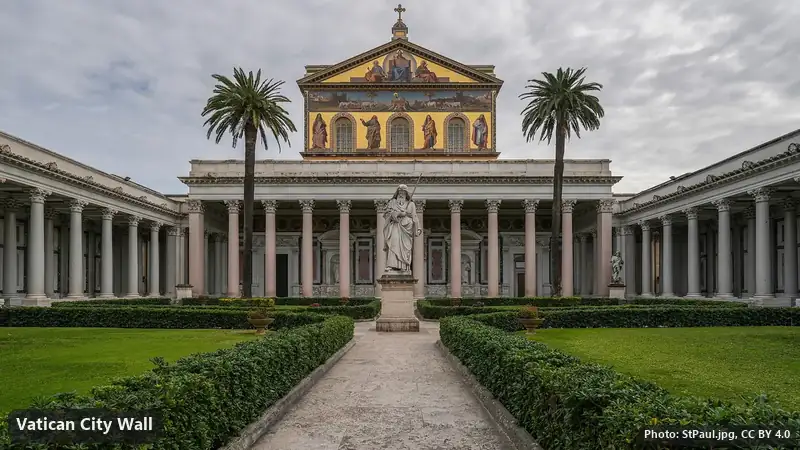
Churches outside the Vatican City wall are part of the picture too, and that surprises people, since not everything the Vatican owns sits inside the walls. The Papal Basilica of St. Paul Outside the Walls lies within Italian territory, but, as Wikipedia explains, the Holy See owns the basilica and it is part of the Vatican’s extraterritoriality.
It is one of Rome’s four major papal basilicas, along with St. John in the Lateran, St. Peter’s and St. Mary Major. The maps data lists it as open from 7 am to 6:30 pm daily, at Piazzale San Paolo in Rome.
This is a handy contrast. St. Peter’s sits inside the Vatican enclosure. St. Paul’s sits far outside it, beyond the ancient Aurelian Walls, yet it is still connected to the Holy See. The name “Outside the Walls” refers to Rome’s old city wall, not to the Vatican wall.
If you are building a church-focused day, you could pair the two. Start with St. Peter’s, then travel across Rome to St. Paul’s. The founding story is a good match. The Wikipedia entry says the first basilica was consecrated by Pope Sylvester in 324 and that Theodosius I began a much larger one in 386.
Going with family? Rome: St. Peter's Basilica, Dome Climb, and Underground Tour, from $33Compare tickets →Vatican City Wall by the Numbers
Vatican City wall figures worth keeping in mind all come from Wikidata, and I’m leaving out wall heights and lengths because neither Wikidata nor the official pages give them.
- Area: 0.44 km² for the whole state. That is why you can see so much of the outside of the enclosure on one short walk.
- Founded as a state: 11 February 1929. The modern state is far younger than the 9th-century walls.
- Population: 949 in 2024. Few people live behind the walls, so most of what you see is institutions, not homes.
- Heritage status: the Vatican is a World Heritage Site.
- St. Paul Outside the Walls, started: 386. It sits outside Rome’s old wall, not the Vatican’s.
- St. Paul’s architect: Luigi Poletti, who rebuilt it in the Early Christian style after the 19th-century fire.
Want a closer look? Rome: St. Peter's Basilica, Papal Tombs, and Dome Climb Tour, from $60See times →
Common Mix-Ups About the Vatican City Wall
Common Vatican City wall mix-ups are worth clearing up, since the ones I see most often cost visitors time on the ground.
The Leonine Walls and the Aurelian Walls are different. The Aurelian Walls are the old city wall of Rome. The Leonine Walls were built later, around St. Peter’s, because the area sat outside the older line.
The wall is not a single tall ring. It is a patchwork of centuries, and some parts are hard to spot because buildings have grown against them.
The Sistine Chapel walls are not defensive. They are painted walls, decorated in the 15th century and again by Michelangelo, whose work on the ceiling and upper wall lunettes the Museums page dates to 1508-1512.
Being near the wall is not the same as being inside the state. You can stand beside the outside of the wall on a public street and still be in Rome, so do not expect passport checks or a ticket office at every corner.
Exact dimensions are often repeated without a source. I do not give a height or length here, because the official pages I rely on do not state one.
Skip the ticket line: Vatican Museums, Sistine Chapel & St. Peter's Basilica Tour, from $60Check dates →Planning Your Visit Around the Vatican City Wall
A Vatican City wall visit works best with a simple plan: spend a few minutes looking at the wall from the street, then go in through a ticketed entrance.
- Pick your main site. Choose the Museums and Sistine Chapel, the Basilica, or both. My overview of the Vatican itself helps you decide.
- Book a timed entry early. The Museums listing uses assigned slots, so arrive inside yours.
- Walk the outside first. Take the street approach, look at the masonry, and then go through security.
- Confirm hours on the official site. Check the Vatican Museums site and the Basilica site before you travel.
- Read the wider background. The About Vatican City hub collects the history and practical guides in one place.
Dress codes and security checks apply at the entrances, so leave time for them. I am not quoting specific rules here because the official pages in my sources do not state them, so check before you go.
Short on time? Rome: Vatican Museums, Sistine Chapel & Basilica Tour, from $71Book a slot →A Short Wrap-Up: What to Remember About the Vatican City Wall
The Vatican City wall began as the Leonine Walls, which Pope Leo IV (847-855) built to protect the settlement around St. Peter’s. It was restored in the late 1200s and early 1300s, and it sits in a landscape that goes back to Roman villas, Nero’s circus and the necropolis where Peter’s tomb was found.
For a visit, my advice is to treat the wall as the setting, not the destination. Look at it from Viale Vaticano or the edge of the Square, then book your way inside. If you want the simplest route, book Vatican tickets online and choose the entry that matches your interests.
If you only remember one thing, remember this: the wall explains why the Vatican looks the way it does, but the collections and the Basilica are why people queue to enter.
Prefer a guide? Vatican Museums & Sistine Chapel Skip-the-Line Entry Ticket, from $53See tours →Top-rated Vatican tickets and tours
Vatican: Museums & Sistine Chapel Entrance Ticket
Powered by GetYourGuide · affiliate link
Rome: St. Peter's Basilica, Dome Climb, and Underground Tour
Powered by GetYourGuide · affiliate link
Rome: St. Peter's Basilica, Papal Tombs, and Dome Climb Tour
Powered by GetYourGuide · affiliate link
Frequently asked questions
Is the Vatican City walled?
Yes. The Vatican has historic defensive walls, first built under Pope Leo IV in the 9th century and known as the Leonine Walls. They were restored in the late 1200s and early 1300s, so what you see today is a layered structure rather than one single build.
What are the Leonine Walls?
The Leonine Walls are the first walls built around the settlement beside St. Peter's tomb, ordered by Pope Leo IV (847-855). The name comes from the Latin form of his name, and the enclosed area was called the Leonine City.
Are the Vatican walls the same as the Aurelian Walls?
No. The Aurelian Walls are the older wall of ancient Rome, and St. Paul Outside the Walls was built beyond them. The Leonine Walls are a separate, later circuit built around St. Peter's.
Can you walk along the Vatican City wall?
You can walk beside the outside of it on public streets, especially on the approach to the Vatican Museums. For the inside of the state you need a ticket to a site such as the Museums or a visit to the Gardens, so check access on the official sites before you plan.
Why was the Vatican City wall built?
It protected the area around St. Peter's Basilica. The Vatican grew up around the tomb of the Apostle Peter, and the 9th-century walls enclosed that pilgrimage center and the buildings around it.
Keep planning your visit
More About Vatican City guides
Online Vatican Tickets is an independent visitor guide. Prices and hours change: check the official Vatican Museums website before you go. Tour links are GetYourGuide affiliate links.